

Being behind the wheel of a car can only be a pleasure if the driver takes responsibility for the way they drive. And it does happen that, for all sorts of reasons, the driver is not able to live up to that responsibility. It is too great a responsibility to be carried by the driver alone. This is why, with the aim of building ever safer cars, driving control systems have been developed so that this responsibility can be shared between the driver and the car. Let’s take a look at the main systems fitted to cars today.
ABS: Antilock Braking System
ABS, the anti-lock braking system, is the first driving control system to be adopted on cars in the history of the motor car. Work on it began as early as the first decades of the twentieth century, but it was Volvo, in 1974, that produced the layout of the system now used by every carmaker. (In the drawing below: how the ABS system works)
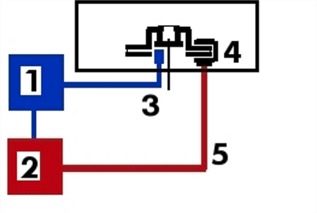
ABS works by modulating braking so that the wheels do not lock. Slowing the vehicle too abruptly risks losing tyre grip, the condition the braking force needs in order to be transmitted to the road. Wheel speed is picked up by a sensor (3) that reads a toothed ring turning with the wheel. As the teeth of the ring go past, the sensor detects the speed of the wheel and sends the data to the electronic control unit (1). If the control unit notices that the wheel is slowing down more abruptly than the car, a sign that it is about to lock, it tells the hydraulic pump (2) to reduce the grip of the pads on the disc (4). The pads return to full grip as soon as the wheel regains the same speed as the vehicle.
BAS: Brake Assistance System
BAS, the brake assist system, helps the driver to brake when the pressure applied to the brake pedal is not enough for what the driver actually intends, for example stopping the car to avoid an obstacle that has suddenly appeared in the road. In this case the system assists braking by reading how quickly the brake pedal is pressed. If that speed exceeds a threshold value, the system acts on the braking circuit and increases the pressure applied to the brake pads. It is also true that the intervention of BAS is balanced by ABS, which naturally steps in to stop BAS applying so much pressure to the brakes that the wheels lock.
TCS: Traction Control System
TCS, the traction control system, prevents the driven wheels from spinning as the vehicle accelerates. Through sensors fitted to the wheels, TCS is able to step in and limit the rotation speed of the wheels, keeping the tyres gripping. That limit can be applied either through the brakes or through the engine’s fuelling. In the first case, to stop drive torque being channelled almost entirely to the spinning wheel at the expense of the wheel that still has grip, the system brakes the spinning wheel and redistributes torque so that it goes to the wheel with grip. In the second case, the system acts on engine fuelling, reducing the torque the engine delivers by just enough to let the tyres grip the road again.
ESP: Electronic Stability Program
ESP, the electronic stability program, is a system that acts when the car begins to slide, working on the engine and the brakes to bring its attitude back under control. It is a sophisticated system, since it relies on the contribution of other assistance systems such as ABS and TCS, as well as on sensors of its own, like the sensor that measures steering angle, so that the control unit can understand the driver’s intentions. Its operating principle, though, is simple: as well as reducing drive torque, one wheel is braked according to how the car is behaving. If the car is understeering, the inner rear wheel is braked. If the car is oversteering, the outer front wheel is braked. In both cases a moment is generated that opposes the car’s deviation from its intended line.