

In a car, power, torque and handling are the elements that define its character, whether sporty or comfortable. To manage all of this, it is important to have a component that makes it possible to control the car’s dynamics according to road conditions and to the driver’s needs. It is the brake that allows the driver to regulate speed and the load transfer of the car. A great deal of research and development work has gone into designing brakes that perform better and better. Today, brakes can be divided into two groups:
- Drum brake
- Disc brake
Drum brake
The drum brake was the first brake fitted to cars, before the speeds they reached called for the development and adoption of disc brakes. Looking at the image on the left, this type of brake works by pushing shoes (6) against a rotating drum fixed to the hub (7). The shoes are actuated by the slave cylinder (1) and pivot around their hinges (4) against the drum. Friction linings are applied to the faces of the shoes that meet the drum, and it is these that slow the drum down. Since friction between shoes and drum wears both components, increasing the travel of the cylinder and therefore of the brake pedal, the resting position of the shoes has to be adjusted by means of cams (9). Once braking is over, return springs (5) bring the shoes back to their starting position. The actuator, shown in section on the right, consists of two small pistons (2) pushed against the shoes by the pressure of the fluid entering through the port (3) and leaving through the threaded port (8). If there is air in the fluid, it escapes through the bleed port (7). The spring (6) keeps the pistons permanently in contact with the shoes and takes up any free play. (Below: a drum brake and sections of its slave cylinder)
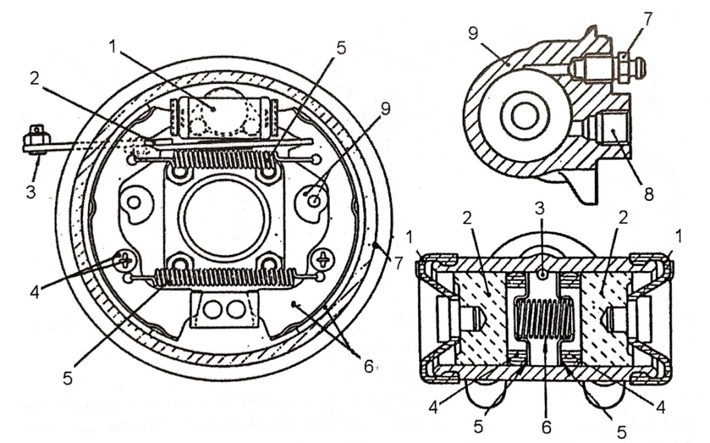
Why were drum brakes superseded by disc brakes? Braking a car travelling at high speed means dissipating its kinetic energy as heat through friction. The faster the car, the higher the temperatures the brake reaches. If the brake is not cooled properly, as is the case with a drum brake, that heat is passed on to the brake fluid and causes fading. Fading is a phenomenon in which part of the brake fluid evaporates because of the high temperatures. As it evaporates, the amount of fluid falls and, with it, the pressure that can be transmitted to the braking components. That loss of pressure can become so severe that the full travel of the brake pedal is no longer enough to bring the vehicle to a complete stop. Today drum brakes are used only on the rear wheels, which are less stressed under braking, and they also integrate well with the parking brake, or handbrake, system.
Disc brake
As car performance increased, it became necessary to develop and adopt the disc brake, a component able to cool itself in order to avoid fading and to deliver a braking force in keeping with the high speeds now being reached. A disc brake generally consists of a disc fixed to the wheel, with holes in the braking surfaces and channels inside the disc whose purpose is to circulate air and cool the disc down. The holes in the braking surfaces also serve to increase friction between the disc and the pads, improving braking power. The pads are linings with a high coefficient of friction that act on the disc through one or more hydraulic pistons and are held by dedicated calipers. Depending on how the caliper is mounted, two types of disc brake can be distinguished:
- Fixed caliper.
- Floating caliper.
(Below: a fixed caliper disc brake and a floating caliper disc brake)
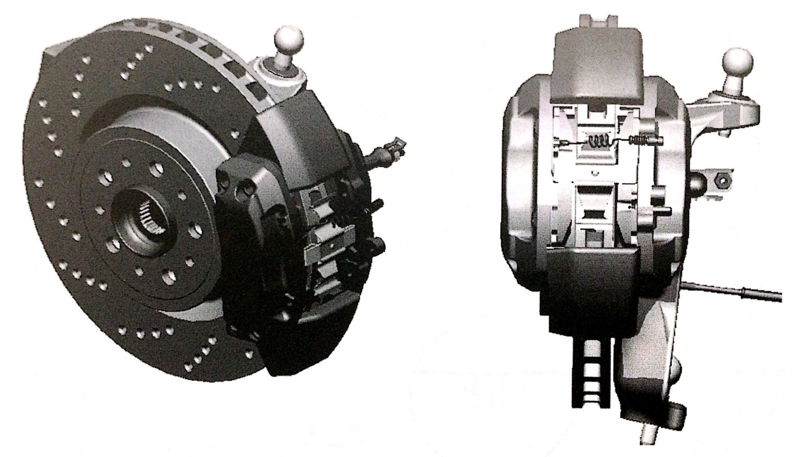
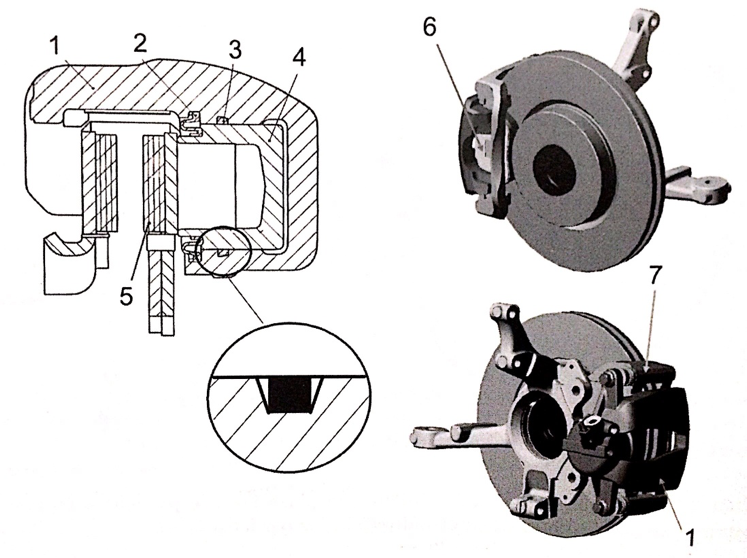
With the fixed caliper, the pads are pressed against the brake disc by pairs of opposing pistons. The pistons, controlled by the same hydraulic circuit, are independent of one another. With the floating caliper, the pistons (4) are found on one side of the caliper only. When the brake is applied, part of the fluid pushes on the pistons while the rest, being incompressible, pushes on the caliper body (1) which, helped by the sliding guides (7), presses on the other side of the disc. In both cases the piston returns to its rest position thanks to radially preloaded elastic seals (3). Compared with the fixed caliper, the floating caliper has the advantage of taking up less axial space and it is cheaper, since it needs fewer components to build. Its drawback is that it cannot guarantee the same braking grip on both sides of the disc if the sliding guides are not properly protected from dirt and corrosion, which can make the movement of the caliper body difficult or impossible.
With disc brakes, the choice of materials for the disc and the pads is important. Grey cast iron is normally used for the disc, since it generally offers good mechanical strength and good heat dissipation. For longer lasting performance, galvanised steel or stainless steel can be considered, the latter working at full effectiveness right from the first stop. On sports cars, ceramic or carbon-ceramic discs are used: they are expensive, but they greatly reduce the risk of fading, they are more durable and lighter, and they have a higher coefficient of friction than steel. In racing, carbon discs are used because, as well as being light, their coefficient of friction increases as temperature rises, unlike steel. Pad materials fall into two groups: organic and sintered. The first is made up of an organic resin acting as a binder and a fibrous part as reinforcement, and it may include friction modifiers of metallic or oxide origin. The second consists of metal powders compacted together through high temperature and high pressure processes. Compared with organic material, it guarantees strong braking power from the very first use, with no need to bed the pad in, and it lasts longer.
The dust generated by friction between pad and disc has long been an environmental problem underrated compared with exhaust emissions, but European regulation is catching up: the Euro 7 standard has, for the first time, introduced limits on particulate emissions from brakes, not only from the exhaust. This is the context for the European project AeroSolfd (Horizon Europe, 2022-2025, €5.0M), which is developing retrofit filtration devices able to capture the dust emitted by the brakes of vehicles already on the road — a bridging solution, useful until Europe’s car fleet is fully electrified.